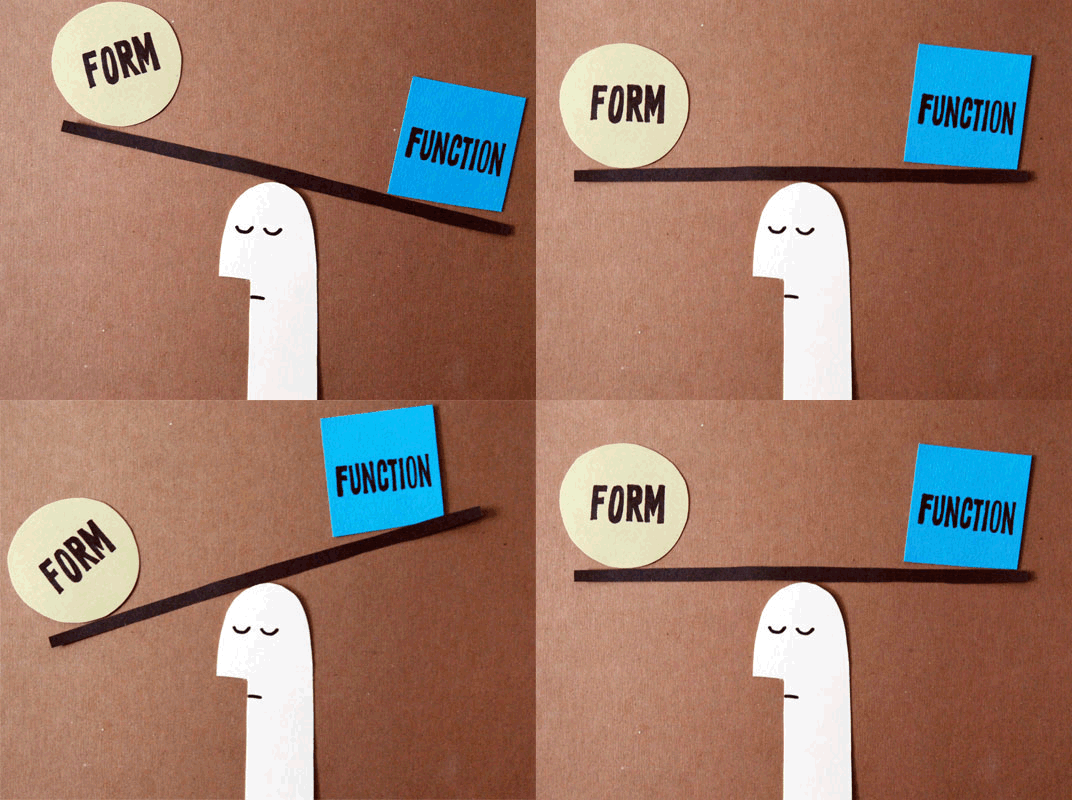
 I am currently teaching an Engineering course. Although this is the first year I have ever taught it (its a new course) I am confident that making A Whole New Mind by Dan Pink one of the central pillars of the course has been a good ideas. The main premise of the book is that in an age of a interconnected global economy, automation, and abundance that its not enough to have strong technical (read left brain) skills, you also need to be able to contextualize and give meaning to what you do (read use the right brain). Basically Pink is saying that the brain needs to balance form and function.
Design Thinking Exercise: Read Design Magazines
One of the things Pink does in his book is identify 6 senses (design, story, symphony, empathy, play, and meaning) that he says are essential for the "whole new mind" he advocates for. For each of these senses he suggests some exercises to enhance the readers' capacity for that sense. For the design chapter I took his advice to read design magazines and spent some time navigating Dwell, which is a magazine and website devoted to design in residential applications.

1) A productive area is not cluttered
2) A beautiful work area has visual connections to other spaces
 Every example had very little stuff laying around. This certainly makes the space nicer looking, but I think it also plays into function. Lots of items, regardless of what they are, serve as distractions. If they are gone, so are the distractions.
The other thing I noticed was obvious in some examples and subtle in others. Every work space provided the person using it a view of another place. In the picture above the man can see into the foyer, in a few the desk was set up in front of a giant window with a great view, but even in the small crowded apartment the mesh behind the desk provided a view into the next room. Although a redesign of a work space probably can't always include a window overlooking a mountain it could certainly provide some sort of orientation that gives the person working a sight line.
This exercise served as a reminder to me that every thing we create represents thousands of decisions. In the work space above it would have been easy to continue the blue wall to divide the room. The designer made an intentional decision to provide a sight line into the next room, which I contend makes all the difference. I suppose that is what separates good design from bad design: thinking about the decisions we make passively to be more intentional about everything.

No comments:
Post a Comment